
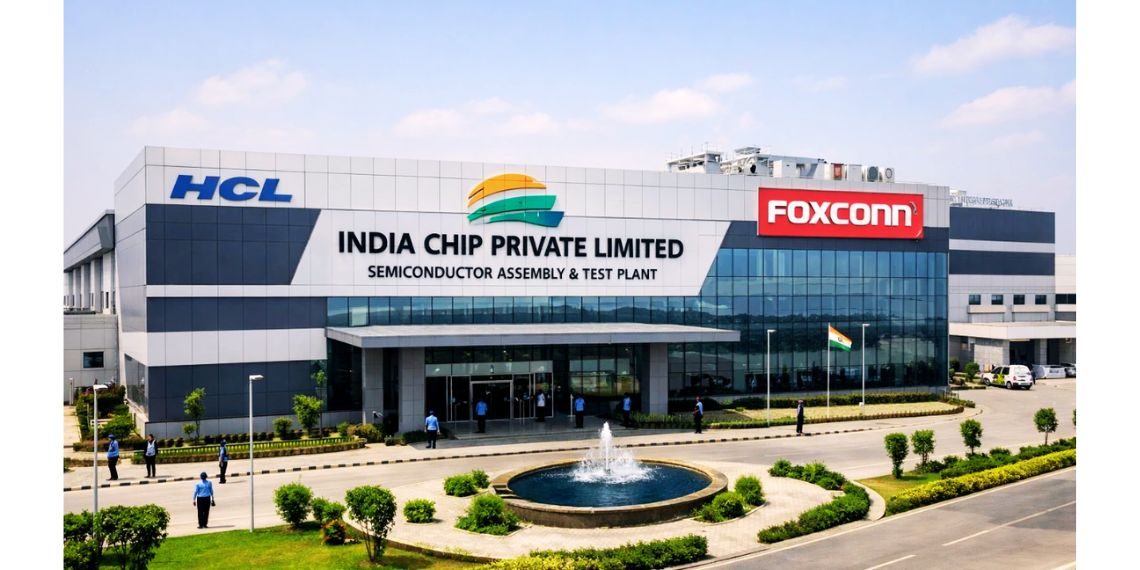
India has taken another decisive step toward strengthening its semiconductor ecosystem as India Chip, a joint venture between HCL Group and Foxconn, begins construction of its semiconductor facility in Noida. The upcoming plant aims to process up to 20,000 wafers per month once fully operational in 2028, significantly boosting domestic production of display driver chips.
Backed by an investment of Rs 3,700 crore, the facility marks a major milestone in India’s ambition to reduce reliance on imported semiconductors and develop a resilient, homegrown chip manufacturing supply chain.
Foundation Stone Laid by Prime Minister Narendra Modi
The foundation stone for the project was recently laid by Narendra Modi, who joined the ceremony virtually. The event was also attended by Yogi Adityanath and Ashwini Vaishnaw.
The plant is being built near Jewar along the Yamuna Expressway in Uttar Pradesh, a region that is rapidly emerging as a key electronics and manufacturing hub.
What the India Chip Facility Will Manufacture
The Noida plant will function as an advanced Outsourced Semiconductor Assembly and Test (OSAT) unit. Rather than fabricating chips from scratch, the facility will:
Assemble semiconductor components
Package integrated circuits
Test display driver chips for performance and reliability
The primary focus will be on display driver integrated circuits (ICs), essential components that power screens in:
Smartphones
Televisions
Laptops
Tablets
Other consumer electronics
Display driver chips play a critical role in translating digital signals into visible images on screens, making them indispensable in today’s digital-first economy.
Processing Capacity: 20,000 Wafers Per Month
Once fully operational in 2028, the India Chip OSAT plant is expected to process up to 20,000 wafers per month. This scale of production positions the facility as one of India’s most significant semiconductor assembly and testing units.
According to company estimates:
The plant could meet nearly 25% of India’s domestic demand for display driver chips.
Approximately 20–30% of output may be exported to global markets.
Currently, India relies entirely on imports for display driver ICs. Local production is expected to reduce external dependencies while strengthening supply chain resilience.
Structure of the Joint Venture
India Chip has been structured as a 60:40 joint venture:
60% stake: HCL Group
40% stake: Foxconn
This partnership combines HCL’s domestic industrial presence and technological expertise with Foxconn’s global electronics manufacturing capabilities. The collaboration reflects a strategic alignment aimed at accelerating India’s semiconductor ambitions.
Boosting India’s Semiconductor Ecosystem
The project comes at a time when India’s electronics manufacturing sector is expanding rapidly, especially in smartphones and consumer devices. As production volumes grow, so does the demand for critical components like display driver chips.
By localising semiconductor assembly and testing, the India Chip facility is expected to:
Reduce import dependence
Improve supply chain stability
Enhance value addition within India
Strengthen the country’s semiconductor infrastructure
Beyond direct manufacturing, the plant is projected to generate over 3,500 direct and indirect jobs. It may also catalyse the development of a broader semiconductor ecosystem, including:
Component suppliers
Logistics providers
Testing and certification services
Ancillary manufacturing units
Strategic Importance of OSAT Facilities
While chip fabrication (fab) plants often attract the most attention, OSAT units are equally critical in the semiconductor value chain. After wafers are fabricated, they must undergo assembly, packaging, and rigorous testing before integration into electronic products.
By establishing a domestic OSAT facility capable of high-volume processing, India strengthens a crucial stage of chip production — one that ensures performance reliability and market readiness.
This move signals India’s intent to transition from being primarily an electronics assembly destination to a higher-value semiconductor manufacturing hub.
Looking Ahead: Operations Targeted for 2028
Construction of the Noida facility is now underway, with operations expected to begin in 2028. Once operational, the plant will serve both domestic and international markets, reinforcing India’s position in the global semiconductor supply chain.
As geopolitical shifts and supply chain disruptions continue to reshape global electronics manufacturing, projects like India Chip represent foundational investments in long-term technological self-reliance.
Conclusion
The launch of construction for the India Chip factory in Noida marks a pivotal moment in India’s semiconductor journey. With a planned capacity of 20,000 wafers per month, significant job creation potential, and the ability to meet a substantial portion of domestic demand for display driver chips, the project underscores India’s strategic push toward self-sufficiency in high-value electronics manufacturing.
As the facility progresses toward its 2028 operational target, it stands as a key pillar in India’s broader mission to build a robust, resilient, and globally competitive semiconductor ecosystem.
Follow Before You Take on:
Latest Technology News | Updates | Latest Electric Vehicle News | Updates | Electronics News | Mobile News | Updates | Software Updates
📌 Facebook | 🐦 Twitter | 📢 WhatsApp Channel | 📸 Instagram | 📩 Telegram | 💬 Threads | 💼 LinkedIn | 🎥 YouTube
🔔 Stay informed, Stay Connected!