
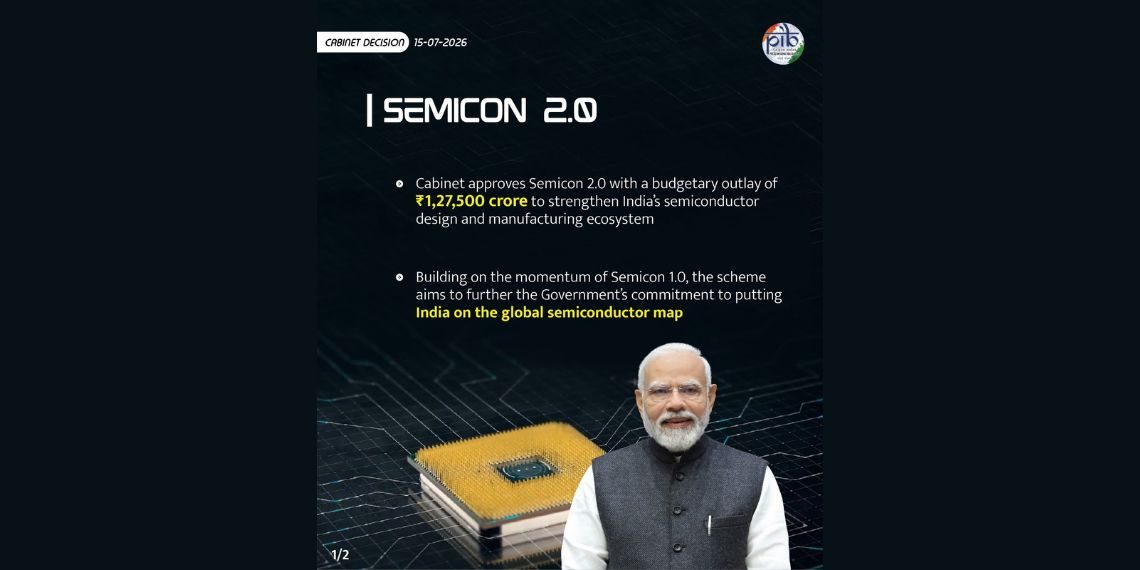
The Union Cabinet, chaired by Prime Minister Narendra Modi, has approved Semicon 2.0, the next phase of India’s ambitious semiconductor mission, with a massive Rs. 1,27,500 crore budget allocation. The new initiative is designed to accelerate India’s journey toward becoming a global semiconductor manufacturing and innovation hub by strengthening every stage of the semiconductor value chain.
Building on the achievements of Semicon 1.0, the upgraded programme focuses on expanding semiconductor design, manufacturing, advanced packaging, research and development, equipment production, raw materials, and workforce development. The initiative is expected to boost India’s technological capabilities, reduce dependence on imports, attract global investments, and create a robust domestic semiconductor ecosystem.
Semicon 2.0: A Major Boost for India’s Chip Industry
Semiconductors have become the backbone of modern technologies, powering everything from smartphones and laptops to electric vehicles, artificial intelligence, telecommunications, medical equipment, and defence systems.
Recognizing the strategic importance of semiconductor manufacturing, the Indian government has significantly expanded its semiconductor policy through Semicon 2.0. The programme aims to establish India as a trusted global destination for semiconductor design, fabrication, packaging, and innovation while improving supply chain resilience and supporting long-term economic growth.
The government believes that a strong domestic semiconductor industry will not only enhance India’s technological self-reliance but also generate high-value employment opportunities and encourage innovation across multiple industries.
Six Key Focus Areas of Semicon 2.0
1. Strengthening Semiconductor Design Capabilities
One of the primary objectives of Semicon 2.0 is to expand India’s semiconductor design ecosystem by supporting the development of semiconductor intellectual property (IP), chip architectures, and complete system-level products.
The programme will encourage startups, MSMEs, and technology companies to develop indigenous semiconductor solutions for both commercial and strategic applications. Building on the progress made by more than 105 startups already working on chip development, the initiative aims to create a globally competitive semiconductor design ecosystem within the country.
By promoting local chip design expertise, India hopes to reduce reliance on imported technologies while creating innovative solutions for emerging industries.
2. Encouraging Semiconductor Manufacturing and Materials
Semicon 2.0 introduces strong incentives for companies involved in semiconductor manufacturing equipment, research and development, specialty materials, industrial chemicals, and process gases that are essential for chip fabrication.
The programme also seeks to attract fresh investments in establishing:
Silicon fabrication plants (Silicon Fabs)
Compound semiconductor fabrication facilities
Discrete semiconductor manufacturing units
Display fabrication plants
According to the government, India’s first commercial semiconductor fabrication plant is expected to become operational by 2028, marking a major milestone in the country’s manufacturing ambitions.
3. Expanding ATMP, OSAT and Advanced Packaging
Advanced packaging has become an increasingly important part of modern semiconductor production.
Semicon 2.0 will encourage investments in:
Assembly
Testing
Marking
Packaging (ATMP)
Outsourced Semiconductor Assembly and Test (OSAT)
The initiative also supports the adoption of next-generation packaging technologies that improve chip performance, energy efficiency, and manufacturing flexibility.
Additionally, research efforts will be expanded beyond the current 28nm to 110nm process technologies, enabling collaboration with leading research institutions in India and internationally for future semiconductor nodes.
4. Investing in Research and Innovation
Innovation remains at the heart of India’s semiconductor roadmap.
Semicon 2.0 will strengthen collaboration between academic institutions, research laboratories, startups, and semiconductor manufacturers to develop advanced chip technologies and next-generation semiconductor processes.
The government aims to create a research ecosystem capable of supporting future applications in artificial intelligence, high-performance computing, automotive electronics, aerospace, defence, and telecommunications.
5. Building a Skilled Semiconductor Workforce
Developing highly skilled talent is another major pillar of Semicon 2.0.
The government noted that 315 universities across India are already using industry-standard Electronic Design Automation (EDA) software to train engineering students in semiconductor design. So far, approximately 68,000 students have received training through these programmes.
The new initiative will further expand:
Chip design education
Industry-led training programmes
Cleanroom operations
Semiconductor fabrication processes
Fab construction skills
Advanced manufacturing expertise
This talent pipeline is expected to support India’s rapidly growing semiconductor industry over the coming years.
6. Strengthening the Complete Semiconductor Value Chain
Unlike previous initiatives that focused on specific segments, Semicon 2.0 aims to develop the entire semiconductor ecosystem.
The programme covers:
Chip design
Semiconductor fabrication
Advanced packaging
Research and development
Manufacturing equipment
Specialty materials
Industrial chemicals
Electronic Design Automation (EDA)
Workforce development
This comprehensive approach is intended to create a sustainable and globally competitive semiconductor industry within India.
Achievements Under Semicon 1.0
The government highlighted the significant progress already achieved through Semicon 1.0.
So far, 12 semiconductor manufacturing projects have been approved with a combined investment exceeding Rs. 1.64 lakh crore.
These projects include:
One Silicon Fab
One Silicon Carbide Fab
One Integrated Gallium Nitride (GaN) Micro LED Display Fab
Nine Semiconductor Packaging Units
These facilities are expected to support multiple industries, including:
Consumer electronics
Industrial automation
Automotive manufacturing
Power electronics
Telecommunications
Aerospace
Defence technologies
Among these projects, Micron, Kaynes, and CG Semi have already commenced commercial production, while another manufacturing facility is expected to begin operations during 2026.
Growing Support for Indian Semiconductor Startups
India’s semiconductor startup ecosystem has also witnessed significant growth.
According to the government:
24 semiconductor design projects have received financial assistance.
More than 105 startups and MSMEs have been provided access to industry-standard Electronic Design Automation (EDA) tools.
These companies are currently developing semiconductor chips and System-on-Chip (SoC) solutions for a wide range of applications, including:
Satellite communications
Drone technology
Surveillance systems
Internet of Things (IoT) devices
LED driver chips
Artificial Intelligence applications
Telecom infrastructure
Smart energy meters
Many of these products are currently progressing through design validation and prototype development before commercial deployment.
Why Semicon 2.0 Matters for India
The semiconductor industry has become one of the world’s most strategically important sectors. Countries are increasingly investing in domestic chip manufacturing to improve supply chain resilience, strengthen national security, and support next-generation technologies.
Through Semicon 2.0, India aims to reduce its dependence on imported semiconductors while creating an ecosystem capable of serving both domestic demand and international markets.
The initiative is expected to:
Strengthen India’s technological self-reliance
Attract global semiconductor investments
Generate high-skilled employment opportunities
Accelerate innovation across multiple industries
Improve supply chain resilience
Enhance national security through domestic chip manufacturing
Final Thoughts
The approval of Semicon 2.0 marks another significant milestone in India’s long-term semiconductor strategy. With an investment of Rs. 1.27 lakh crore, the government is laying the foundation for a comprehensive semiconductor ecosystem that spans chip design, manufacturing, advanced packaging, research, materials, equipment, and workforce development.
Combined with the progress already achieved under Semicon 1.0, the new programme positions India to emerge as a major global player in semiconductor manufacturing and innovation over the coming decade. As semiconductor demand continues to rise worldwide, Semicon 2.0 could play a crucial role in driving economic growth, technological advancement, and India’s vision of becoming a global electronics manufacturing powerhouse.
FAQs
1. What is Semicon 2.0 and why has the Indian government launched it?
Semicon 2.0 is India’s next-phase semiconductor development programme approved with a budget of Rs. 1.27 lakh crore. It aims to strengthen the country’s semiconductor ecosystem by supporting chip design, manufacturing, advanced packaging, research, equipment, materials, and talent development while reducing dependence on imported semiconductors.
2. What are the key focus areas of Semicon 2.0?
Semicon 2.0 focuses on six major areas: semiconductor chip design, manufacturing equipment and materials, silicon and compound semiconductor fabs, ATMP and OSAT facilities, advanced research and development, and workforce training. The programme is designed to build a complete semiconductor value chain in India.
3. How will Semicon 2.0 benefit India’s technology and manufacturing sector?
Semicon 2.0 is expected to attract new investments, create high-skilled jobs, boost domestic semiconductor production, support startups and MSMEs, strengthen supply chain resilience, and position India as a global hub for semiconductor design, manufacturing, and advanced electronics over the coming years.
Follow Before You Take on:
Latest Technology News | Updates | Latest Electric Vehicle News | Updates | Electronics News | Mobile News | Updates | Software Updates
📌 Facebook | 🐦 Twitter | 📢 WhatsApp Channel | 📸 Instagram | 📩 Telegram | 💬 Threads | 💼 LinkedIn | 🎥 YouTube
🔔 Stay informed, Stay Connected!