
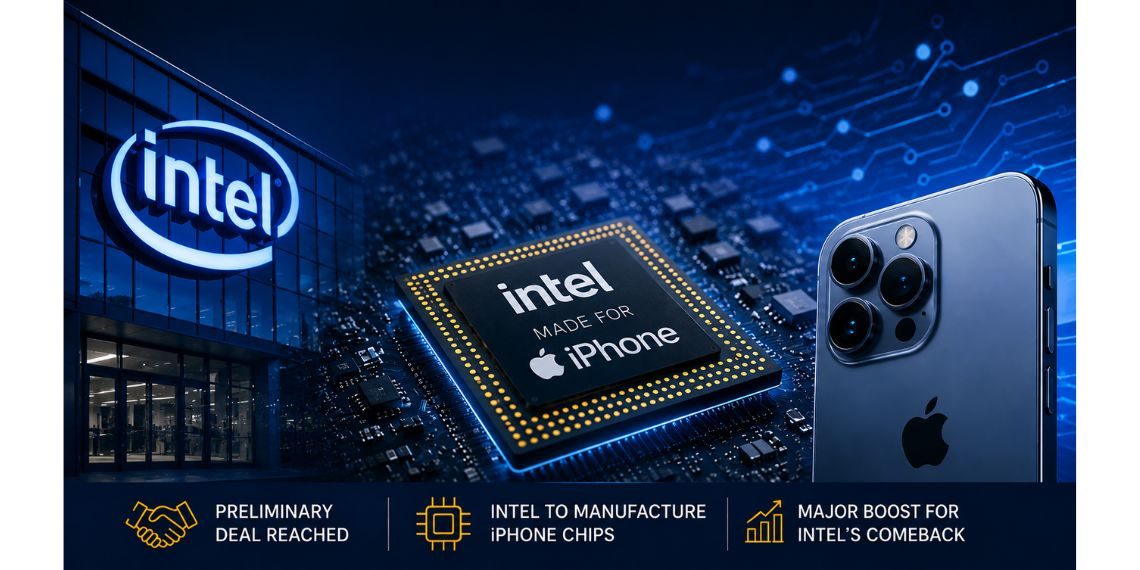
In a surprising development that could reshape the global semiconductor landscape, reports suggest that Intel and Apple are moving toward a preliminary agreement that may see Intel manufacturing chips for future Apple devices. The potential partnership marks a significant moment for both companies, especially considering Apple’s high-profile transition away from Intel processors in recent years.
According to reports, the discussions between the two tech giants have progressed through the initial stages, signaling a possible strategic alliance aimed at reducing Apple’s reliance on Taiwan Semiconductor Manufacturing Company (TSMC). If finalized, the deal could have a far-reaching impact on chip manufacturing, supply chain diversification, and the future of semiconductor production in the United States.
The reported agreement also aligns with broader geopolitical and economic goals, particularly the US government’s push to strengthen domestic semiconductor manufacturing capabilities amid rising global competition and increasing demand for AI-focused chips.
Key Highlights
Intel may soon manufacture chips for future Apple devices
Apple is reportedly seeking to reduce dependence on TSMC
The deal could boost Intel’s struggling foundry business
US government officials reportedly played a major role in negotiations
Partnership may support America’s domestic semiconductor ambitions
Intel is also working with NVIDIA and Elon Musk-linked projects
AI chip demand is reshaping the global semiconductor industry
Why Apple Could Return to Intel for Chip Manufacturing
Apple’s shift to in-house Apple Silicon chips was considered one of the company’s most successful hardware transitions. Beginning with the Apple M1 chip in 2020, Apple demonstrated significant improvements in performance, power efficiency, and thermal management compared to Intel-powered Macs.
However, while Apple designs its own processors, the manufacturing of these advanced chips is currently handled primarily by TSMC. As the AI boom accelerates globally, TSMC’s production capacity has become increasingly crowded with orders from major companies including NVIDIA, AMD, Qualcomm, and others.
This growing pressure on semiconductor fabrication capacity appears to be one of the key reasons Apple is now exploring additional manufacturing partnerships.
By working with Intel, Apple could:
Diversify its manufacturing supply chain
Reduce overdependence on a single chip foundry
Secure additional production capacity for future products
Improve supply chain resilience amid geopolitical uncertainties
Potentially increase chip manufacturing within the United States
The move reflects a broader industry trend where major technology companies are actively seeking multi-source semiconductor manufacturing strategies.
Intel’s Foundry Ambitions Receive a Major Boost
For Intel, a partnership with Apple could become one of the most important milestones in its ongoing transformation strategy.
Once the undisputed leader in semiconductor manufacturing, Intel has faced mounting competition over the past decade. The company struggled to maintain leadership in smartphone chips while competitors such as Qualcomm and ARM-based solutions rapidly gained market dominance.
Additionally, AMD’s Ryzen processors significantly challenged Intel’s long-standing dominance in the PC processor market.
To recover its position, Intel has heavily invested in its foundry business — a strategy focused on manufacturing chips for external companies rather than solely producing processors for its own products.
Landing Apple as a customer would offer several major benefits for Intel:
Strengthening Industry Reputation
Apple is one of the world’s largest and most influential technology companies. Securing Apple as a manufacturing partner would instantly validate Intel’s foundry capabilities in the eyes of the industry.
Stable Long-Term Demand
Apple ships millions of devices annually, including iPhones, iPads, MacBooks, and wearables. A manufacturing partnership could provide Intel with a steady and large-scale source of business.
Accelerating US Semiconductor Manufacturing
Intel has been aggressively expanding its manufacturing infrastructure in the United States. Partnering with Apple could help maximize utilization of these advanced fabrication facilities.
Apple and Intel: A Relationship That Comes Full Circle
Apple and Intel once shared a close partnership that shaped the modern Mac era.
The Intel Mac Era
In 2006, Apple officially transitioned its Mac lineup from PowerPC processors to Intel chips. This shift enabled Apple devices to deliver better performance and compatibility with software ecosystems.
For over a decade, Intel processors powered MacBooks, iMacs, and Mac Pro systems.
Why Apple Moved Away From Intel
Despite years of collaboration, Apple eventually began facing several challenges with Intel chips, including:
Manufacturing delays
Thermal management problems
Power efficiency concerns
Slower innovation cycles
These limitations pushed Apple toward developing its own custom silicon solutions.
The introduction of the Apple M1 chip in 2020 marked a turning point. Apple Silicon dramatically improved battery life, performance efficiency, and integration across Apple devices.
Now, while Apple is unlikely to abandon its own chip designs, using Intel as a manufacturing partner would represent a new chapter in the relationship between the two companies.
The Growing Importance of AI in the Semiconductor Industry
The timing of this potential partnership is closely linked to the ongoing artificial intelligence boom.
AI technologies are driving unprecedented demand for advanced semiconductor production. Companies such as NVIDIA, AMD, Microsoft, Google, and Meta are rapidly increasing investments in AI hardware infrastructure.
As a result:
Advanced chip manufacturing capacity is becoming increasingly limited
Semiconductor foundries are under immense pressure
Companies are seeking alternative manufacturing partners
Intel is positioning itself as a major player in this AI-driven semiconductor era by expanding its manufacturing ecosystem and partnering with leading technology firms.
Reports also suggest Intel has signed agreements with NVIDIA and projects linked to Elon Musk’s Tesla, SpaceX, and xAI operations.
This growing network of partnerships could help Intel re-establish itself as a central force in global chip production.
US Government’s Role in the Negotiations
One of the most interesting aspects of the reported Apple-Intel discussions is the involvement of the US government.
According to reports, US Commerce Secretary Howard Lutnick held multiple meetings with Apple executives over the past year in an effort to encourage collaboration with Intel.
The US government has prioritized rebuilding domestic semiconductor manufacturing capabilities after years of heavy reliance on overseas production, particularly in Asia.
This strategy gained momentum following:
Global chip shortages
Supply chain disruptions
Rising geopolitical tensions
Growing competition in AI technologies
The reported Apple-Intel partnership could support several US policy objectives:
Boosting Domestic Chip Production
Increasing semiconductor manufacturing within the United States is viewed as critical for economic and national security.
Reducing Foreign Dependency
The US aims to reduce reliance on overseas chip foundries, especially as global semiconductor demand continues to rise.
Supporting Advanced Technology Leadership
Semiconductors are essential for AI, cloud computing, defense systems, electric vehicles, and next-generation consumer electronics.
A stronger domestic chip ecosystem is increasingly seen as a strategic national priority.
What This Could Mean for Future Apple Devices
While specific product details remain unknown, the reported partnership could eventually impact several Apple product categories, including:
iPhones
iPads
MacBooks
AI-focused hardware
Future wearable devices
Apple would likely continue designing its own processors while outsourcing manufacturing to multiple partners, including TSMC and potentially Intel.
This hybrid strategy could improve production flexibility while ensuring Apple maintains control over chip architecture and optimization.
Challenges Intel Still Needs to Overcome
Despite the potential benefits, Intel still faces significant challenges.
Competing With TSMC
TSMC remains the global leader in advanced semiconductor manufacturing, particularly at smaller process nodes.
Intel will need to demonstrate:
Competitive manufacturing yields
Reliable production timelines
Advanced fabrication capabilities
Strong power efficiency performance
Regaining Market Confidence
Years of delays and missed manufacturing milestones have affected Intel’s reputation. Successfully executing large-scale Apple contracts would require flawless operational performance.
Managing AI Demand
As AI workloads continue to grow, Intel must balance demand from multiple high-profile clients while maintaining manufacturing quality and scalability.
Conclusion
The reported preliminary agreement between Intel and Apple could become one of the most significant semiconductor partnerships in recent years. While Apple is expected to continue designing its own custom silicon, bringing Intel into its manufacturing ecosystem could help diversify production, strengthen supply chain resilience, and support broader US semiconductor ambitions.
For Intel, the partnership represents an opportunity to rebuild its reputation and accelerate its transformation into a global foundry powerhouse. For Apple, it could provide greater manufacturing flexibility during a time when AI-driven demand is reshaping the entire semiconductor industry.
Although the deal has not yet been officially finalized, the potential collaboration highlights how rapidly the global chip market is evolving — driven by artificial intelligence, geopolitical priorities, and the growing importance of advanced semiconductor manufacturing.
Follow Before You Take on:
Latest Technology News | Updates | Latest Electric Vehicle News | Updates | Electronics News | Mobile News | Updates | Software Updates
📌 Facebook | 🐦 Twitter | 📢 WhatsApp Channel | 📸 Instagram | 📩 Telegram | 💬 Threads | 💼 LinkedIn | 🎥 YouTube
🔔 Stay informed, Stay Connected!