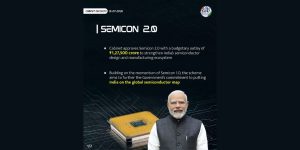

India is accelerating its journey toward becoming a global semiconductor hub. In a significant move, the Union Cabinet has approved two new semiconductor manufacturing projects in Gujarat, with a combined investment of over ₹3,900 crore. These projects fall under the ambitious India Semiconductor Mission (ISM), aimed at strengthening the country’s chip manufacturing ecosystem.
The development marks a major milestone, including the establishment of India’s first commercial Mini/Micro-LED display facility based on Gallium Nitride (GaN) technology, alongside a large-scale semiconductor packaging unit.
Key Highlights
Two new semiconductor plants approved under ISM
Total investment of approximately ₹3,936 crore
Over 2,200 skilled jobs expected
India’s first GaN-based Mini/Micro-LED facility to be set up
New OSAT semiconductor packaging unit in Surat
Total ISM projects now reach 12, with ₹1.64 lakh crore investment
Project Overview: Strengthening India’s Semiconductor Ecosystem
The newly approved projects are part of a broader government strategy to reduce dependency on imports, boost domestic manufacturing, and position India as a reliable player in the global semiconductor supply chain.

Key Objectives
Develop advanced semiconductor manufacturing capabilities
Build a robust display technology ecosystem
Support emerging technologies like AR/VR and smart devices
Create high-skilled employment opportunities
Crystal Matrix Limited (CML): India’s First GaN-Based Display Facility
Location
Dholera, Gujarat
Core Focus
Crystal Matrix Limited will establish an integrated facility for:
Compound semiconductor fabrication
Assembly, Testing, Marking, and Packaging (ATMP)
Mini/Micro-LED display manufacturing
Technology Advantage: Gallium Nitride (GaN)
The facility will utilize Gallium Nitride (GaN) technology, known for:
Higher efficiency compared to traditional silicon
Better performance in high-power applications
Enhanced durability and thermal stability
Production Capacity
72,000 square meters of Mini/Micro-LED display panels annually
24,000 sets of RGB Mini/Micro-LED GaN epitaxy wafers
Target Applications
Large displays: TVs and commercial signage
Medium displays: Smartphones, tablets, automotive systems
Micro displays: AR/VR glasses, smartwatches
This project positions India at the forefront of next-generation display manufacturing, a sector expected to grow rapidly in the coming years.
Suchi Semicon Private Limited (SSPL): OSAT Facility in Surat
Location
Surat
Core Focus
Suchi Semicon will set up an Outsourced Semiconductor Assembly and Test (OSAT) facility.
What is OSAT?
OSAT facilities handle:
Chip assembly
Testing and quality assurance
Packaging for final deployment
These processes are critical in the semiconductor value chain, ensuring chips are ready for real-world applications.
Production Capacity
1,033.20 million chips annually
Target Applications
Power electronics
Analog integrated circuits (ICs)
Automotive systems
Industrial automation
Consumer electronics
This facility will strengthen India’s backend semiconductor capabilities, which are essential for scaling domestic production.
Employment and Economic Impact
The two projects are expected to create approximately 2,230 skilled jobs, contributing to:
Workforce development in high-tech manufacturing
Growth of local economies in Gujarat
Expansion of India’s semiconductor talent pool
Additionally, these investments will attract further global partnerships and supply chain collaborations.
Broader Impact on India Semiconductor Mission
With these approvals, the total number of projects under the India Semiconductor Mission rises to 12, with cumulative investments reaching around ₹1.64 lakh crore.
Current Progress
Multiple projects are in advanced stages of execution
Two facilities have already started commercial shipments
Additional units are expected to begin operations soon
Boost to Chip Design and Innovation
Alongside manufacturing, the government is also investing heavily in chip design infrastructure.
Key Developments
Support extended to 315 academic institutions
Backing provided to 104 startups
This dual focus on design and manufacturing ensures a complete semiconductor ecosystem, from concept to production.
Strategic Importance for India
Reducing Import Dependency
India currently relies heavily on imported semiconductors. These projects aim to:
Strengthen domestic production
Improve supply chain resilience
Enabling Future Technologies
The new facilities will support industries such as:
Artificial Intelligence (AI)
Electric vehicles (EVs)
5G and telecommunications
Consumer electronics
Positioning India Globally
By investing in advanced technologies like GaN and Mini/Micro-LED displays, India is positioning itself as a competitive player in the global semiconductor market.
Challenges and the Road Ahead
While the progress is promising, the semiconductor sector faces challenges such as:
High capital investment requirements
Rapid technological evolution
Global competition
However, consistent policy support and strategic investments are helping India overcome these barriers.
Conclusion
The approval of two new semiconductor plants in Gujarat marks a crucial step in India’s journey toward technological self-reliance. With investments exceeding ₹3,900 crore, the projects not only boost manufacturing capabilities but also strengthen the country’s position in next-generation technologies like GaN-based displays.
As the India Semiconductor Mission continues to gain momentum, these developments signal a future where India plays a central role in the global semiconductor ecosystem, driving innovation, creating jobs, and powering the digital economy.
Follow Before You Take on:
Latest Technology News | Updates | Latest Electric Vehicle News | Updates | Electronics News | Mobile News | Updates | Software Updates
📌 Facebook | 🐦 Twitter | 📢 WhatsApp Channel | 📸 Instagram | 📩 Telegram | 💬 Threads | 💼 LinkedIn | 🎥 YouTube
🔔 Stay informed, Stay Connected!